By: Mark Vruno
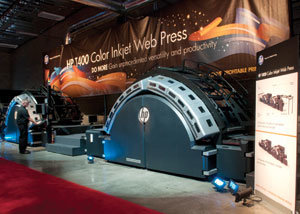
Wide, High-Speed Digital Web Presses Are Full of Promise Digital rumblings are nothing new in the printing industry — newspapers or otherwise. But the past six months or so have been interesting, to say the least, with some strange bedfellows emerging to lead the print innovation charge: partners KBA and RR Donnelley; manroland and Océ; Konica Minolta selling Screen’s Truepress Jet520; and, most notably perhaps, Heidelberg and Ricoh. After selling its web-offset division to Goss and its NexPress digital print technology to Kodak several years ago, the struggling sheetfed press manufacturer is back in the digital print game. Océ (now part of Canon) and manroland are expected to roll out a new digital press platform for newspapers and other users in the second half of 2011. The two firms exhibited together for the first time at the digi:media exposition in Germany last month. Océ also signed an agreement with Tensor Group Inc. to jointly market Tensor’s single-wide presses in certain regions of the globe. Meanwhile, KBA and RR Donnelley, North America’s largest printer, have agreed to develop, manufacture, and sell a piezoelectric-based inkjet press. Set to debut at Drupa 2012 next May, they’re targeting the commercial, newspaper, packaging, and security sectors. KBA has licensed Donnelley’s Apollo digital technology to use in its own presses. The manufacturer spent 18 months assessing current and future digital printing technologies from around the globe, said chief executive Helge Hansen, adding that this is “more than a sales and service agreement for existing technology.” HP introduced its first high-speed inkjet web press at Germany’s giant Drupa tradeshow in 2008. Last month, it unveiled a wider (42-inch web), faster, fourth-generation model — the T400 — that makes the concept of mass customization even more of a reality. The digital press runs at speeds up to 600 feet per minute and can print 5,200 full-color, letter-size pages per minute. Its smaller cousin, the 30-inch T300, features output capacities as high as 70 million pages per month. To date, Hewlett-Packard has more than 20 global installations of full-color inkjet webs (a total of 42 print engines) with a production volume amounting to some 3 billion pages, it reports. But they’re being used primarily for book and direct mail application, not newspapers, despite claims to the contrary three years ago. The problem, HP says, is that while newspaper publishers may have the vision, cash flow still is a problem for these multimillion-dollar digital press investments. One guy who might figure it out is Jim Lucanish, president of O’Neil Data Systems in Los Angeles, one of HP’s biggest inkjet web customers. Beginning next month, O’Neil is installing a pair of the T400 models in its new 218,000-square-foot plant in Plano, Texas; the all-digital facility is set to be operational by August. Its parent company publishes and prints Investor’s Business Daily and still does so with conventional offset. But Lucanish believes it’s only a matter of time (and money, of course) before progressive newspaper publishers learn how to use inkjet technology to their best advantage. Last spring at the Ipex show in the U.K., Kodak debuted its narrower (24.5 inches) Prosper inkjet web digital press. Tribune Co. subsidiary Tribune Direct in Northlake, Ill., opted for Kodak’s “Stream” technology. The firm was the first direct marketing company to buy the color Prosper 5000XL model, set to go into operation this summer, and is one of only a handful of U.S. newspaper publishers to deploy digital printing. “We researched available technologies and were drawn to the Prosper because it runs multiple substrates,” president/general manager Lou Tazioli told the Graph Expo Show Daily last October, when the press was purchased. “We are going to offer its speed (650 linear fpm) to marketers who have an interest in self-mailers and postcards.” Tribune Direct installed a Kodak NexPress in the fall of 2009, “and our net volume is up 100 percent now,” said operations director Tim Street. “It runs 20 hours a day, seven days a week.” The company may use the new press to support short-run, niche publications with larger signatures. “It moves a lot of paper,” Tazioli said. “We’re looking at the economics and timing of our TribLocal product’s custom advertising, for example.” Their projections show Prosper producing at 50 to 60 percent capacity within five years. “Utilization depends on managing schedules and customer turnaround requirements,” said sales/client relations VP Tim Klunder. While conceivable that Tribune also may use the press to produce special sections and niche publications for the Chicago Tribune, Tazioli said that using the Prosper to print newspaper-oriented pieces is not a primary goal — at least not yet.

 Wide, High-Speed Digital Web Presses Are Full of Promise Digital rumblings are nothing new in the printing industry — newspapers or otherwise. But the past six months or so have been interesting, to say the least, with some strange bedfellows emerging to lead the print innovation charge: partners KBA and RR Donnelley; manroland and Océ; Konica Minolta selling Screen’s Truepress Jet520; and, most notably perhaps, Heidelberg and Ricoh. After selling its web-offset division to Goss and its NexPress digital print technology to Kodak several years ago, the struggling sheetfed press manufacturer is back in the digital print game. Océ (now part of Canon) and manroland are expected to roll out a new digital press platform for newspapers and other users in the second half of 2011. The two firms exhibited together for the first time at the digi:media exposition in Germany last month. Océ also signed an agreement with Tensor Group Inc. to jointly market Tensor’s single-wide presses in certain regions of the globe. Meanwhile, KBA and RR Donnelley, North America’s largest printer, have agreed to develop, manufacture, and sell a piezoelectric-based inkjet press. Set to debut at Drupa 2012 next May, they’re targeting the commercial, newspaper, packaging, and security sectors. KBA has licensed Donnelley’s Apollo digital technology to use in its own presses. The manufacturer spent 18 months assessing current and future digital printing technologies from around the globe, said chief executive Helge Hansen, adding that this is “more than a sales and service agreement for existing technology.” HP introduced its first high-speed inkjet web press at Germany’s giant Drupa tradeshow in 2008. Last month, it unveiled a wider (42-inch web), faster, fourth-generation model — the T400 — that makes the concept of mass customization even more of a reality. The digital press runs at speeds up to 600 feet per minute and can print 5,200 full-color, letter-size pages per minute. Its smaller cousin, the 30-inch T300, features output capacities as high as 70 million pages per month. To date, Hewlett-Packard has more than 20 global installations of full-color inkjet webs (a total of 42 print engines) with a production volume amounting to some 3 billion pages, it reports. But they’re being used primarily for book and direct mail application, not newspapers, despite claims to the contrary three years ago. The problem, HP says, is that while newspaper publishers may have the vision, cash flow still is a problem for these multimillion-dollar digital press investments. One guy who might figure it out is Jim Lucanish, president of O’Neil Data Systems in Los Angeles, one of HP’s biggest inkjet web customers. Beginning next month, O’Neil is installing a pair of the T400 models in its new 218,000-square-foot plant in Plano, Texas; the all-digital facility is set to be operational by August. Its parent company publishes and prints Investor’s Business Daily and still does so with conventional offset. But Lucanish believes it’s only a matter of time (and money, of course) before progressive newspaper publishers learn how to use inkjet technology to their best advantage. Last spring at the Ipex show in the U.K., Kodak debuted its narrower (24.5 inches) Prosper inkjet web digital press. Tribune Co. subsidiary Tribune Direct in Northlake, Ill., opted for Kodak’s “Stream” technology. The firm was the first direct marketing company to buy the color Prosper 5000XL model, set to go into operation this summer, and is one of only a handful of U.S. newspaper publishers to deploy digital printing. “We researched available technologies and were drawn to the Prosper because it runs multiple substrates,” president/general manager Lou Tazioli told the Graph Expo Show Daily last October, when the press was purchased. “We are going to offer its speed (650 linear fpm) to marketers who have an interest in self-mailers and postcards.” Tribune Direct installed a Kodak NexPress in the fall of 2009, “and our net volume is up 100 percent now,” said operations director Tim Street. “It runs 20 hours a day, seven days a week.” The company may use the new press to support short-run, niche publications with larger signatures. “It moves a lot of paper,” Tazioli said. “We’re looking at the economics and timing of our TribLocal product’s custom advertising, for example.” Their projections show Prosper producing at 50 to 60 percent capacity within five years. “Utilization depends on managing schedules and customer turnaround requirements,” said sales/client relations VP Tim Klunder. While conceivable that Tribune also may use the press to produce special sections and niche publications for the Chicago Tribune, Tazioli said that using the Prosper to print newspaper-oriented pieces is not a primary goal — at least not yet.




Comments
No comments on this item Please log in to comment by clicking here