
For generations, the decision to carry a presidential address live required little debate inside America’s newsrooms. A president speaking directly to the nation was considered a civic event, one that broadcast networks had an obligation to deliver uninterrupted to the public. Viewers could expect analysis and commentary afterward, but the speech itself was largely treated as sacrosanct.
That unwritten rule no longer exists.
Last night’s prime-time address from President Donald Trump on election security, laid bare just how dramatically journalism has changed. The speech itself generated headlines, but perhaps more revealing were the editorial decisions made by the news organizations covering it. Some networks declined to carry the address live at all. Others interrupted programming to air it. And two organizations — Fox News and CBS News — offered what may prove to be an important blueprint for journalism in the age of misinformation.
Though they approached the evening from very different editorial traditions, both reached a remarkably similar conclusion: covering a president live does not eliminate a newsroom’s responsibility to verify what viewers are hearing.
That distinction matters.
For years, journalism has struggled to answer an increasingly difficult question. How should news organizations cover public officials who possess immense news value but also have documented histories of making inaccurate or unsupported claims? Airing every statement without context risks amplifying misinformation. Refusing to cover significant presidential remarks invites accusations of censorship or political bias.
Increasingly, newsrooms are searching for a middle ground.
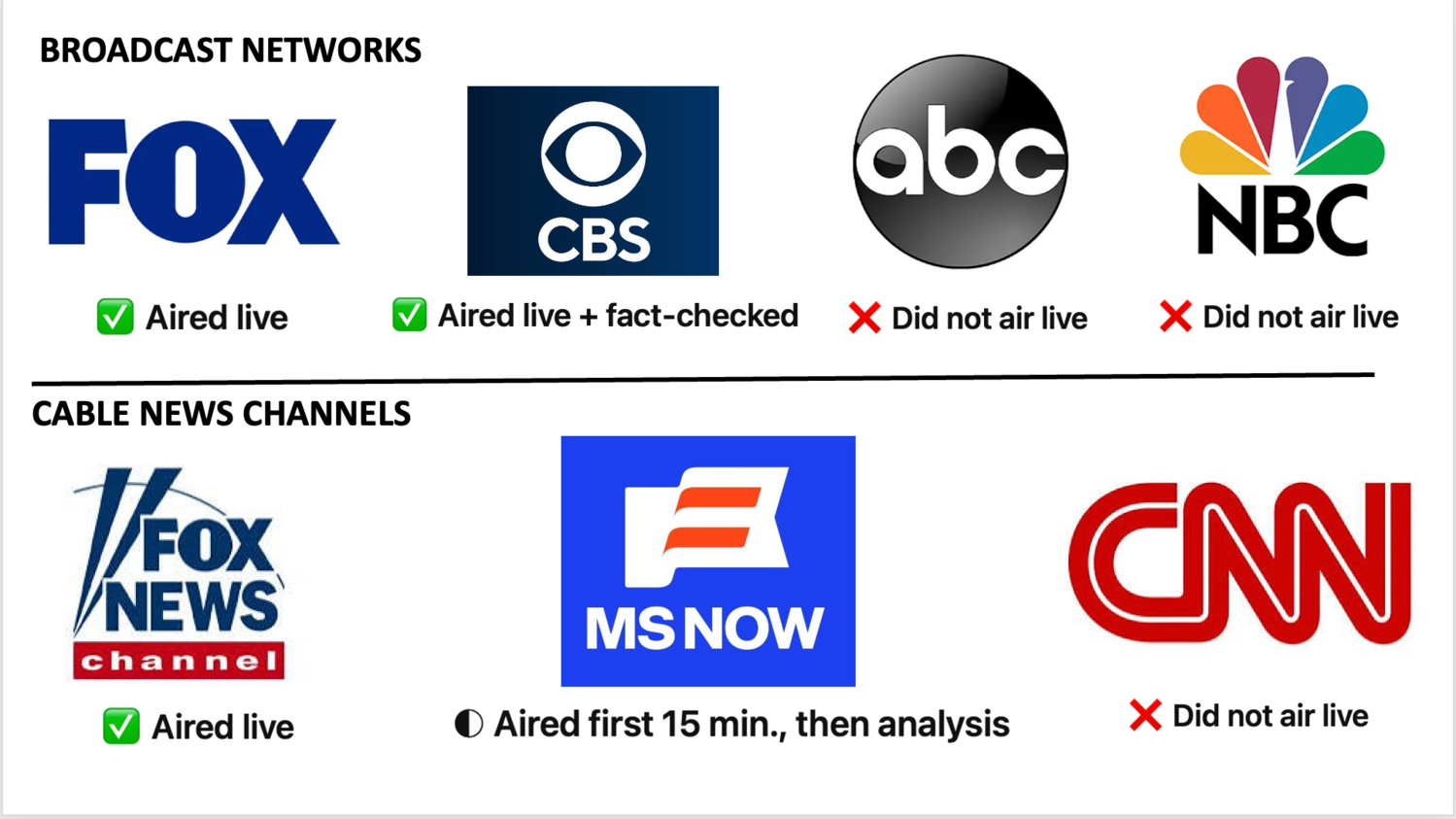
Fox News, whose relationship with President Trump has often been closely scrutinized, aired the address live. But immediately afterward, its anchors reminded viewers that the network had not independently verified the president’s claims regarding voting machines and election security. The disclaimer was concise but significant. It acknowledged both the importance of the presidential address and the newsroom’s obligation not to present contested claims as established fact.
That simple statement represented more than a disclaimer. It reflected lessons learned from one of the most consequential legal cases in modern journalism. Following its settlement with Dominion Voting Systems, Fox now operates in an environment where verification carries heightened legal and journalistic importance. Whether motivated by editorial philosophy, legal prudence or both, the result was the same: viewers were told what the president claimed — and equally important, what the network could not independently confirm.
CBS News took a different route, but arrived at a similar destination.
The network introduced the speech by reminding viewers that President Trump has previously made false claims regarding election integrity. Rather than allowing the address to stand on its own, CBS framed it as breaking news deserving close scrutiny. The network then cut away shortly before the speech concluded to begin immediate on-air analysis, while its CBS News Confirmed team simultaneously published detailed fact-checks evaluating the president’s central assertions against available evidence from election officials, federal agencies and public records.
Different approach.
Same principle.
Journalism’s responsibility does not end simply because a speech is live.
That may seem obvious, but it represents a profound departure from traditional broadcast norms. There was a time when editors largely believed audiences would separate political rhetoric from objective fact. Today’s information ecosystem operates differently. Clips are instantly isolated, reposted across social media, stripped of context and viewed millions of times before professional reporting catches up. In that environment, delaying verification until the evening news — or even until the speech ends — can allow unsupported claims to become accepted narratives.
The implications extend well beyond national television.
Local publishers confront similar editorial choices every day.
Should a local news outlet publish a letter to the editor containing assertions it knows cannot be substantiated? Should a newsroom livestream a contentious city council meeting without providing real-time context when public officials make demonstrably false statements? Should a broadcaster air a press conference uninterrupted when factual claims remain in dispute?
These questions no longer have easy answers.
Historically, journalism often separated reporting from verification. Report first. Analyze later.
Increasingly, those two responsibilities have merged.
That shift has generated criticism from across the political spectrum. Some argue that providing fact-checks alongside live events introduces editorial bias into what should be straightforward coverage. Others contend that refusing to immediately challenge falsehoods amounts to journalistic malpractice. The tension reflects a broader debate over the role of news organizations in an era where trust in institutions continues to erode.
But perhaps this week’s coverage offers another way to think about the issue.
Neither Fox News nor CBS News prevented viewers from hearing the president’s remarks. Neither attempted to silence the speech itself. Instead, both recognized that journalism involves more than transmitting information from one microphone to another. It requires helping audiences distinguish verified fact from unverified assertion.
That distinction should not be viewed as partisan.
It should be viewed as professional.
Editors make comparable decisions every day. They verify quotations before publication. They seek multiple sources before reporting allegations. They require documentation before printing accusations that could damage reputations. No one considers those practices censorship. They are the very foundation of responsible journalism.
Presidential speeches deserve no less.
This is particularly relevant as technology continues reshaping how news is consumed. Artificial intelligence can now generate convincing fake audio and video. Social media platforms reward emotional engagement over factual accuracy. Political narratives spread globally within minutes. Against that backdrop, newsroom verification has become more valuable — not less.
None of this means journalists should refuse to cover controversial leaders or contentious issues. Quite the opposite. The public benefits when citizens hear directly from elected officials. But audiences also deserve transparent reporting that clearly distinguishes what is known, what remains unverified and what available evidence actually shows.
Perhaps that is the emerging standard.
Not unfiltered coverage.
Not selective silence.
But transparent verification.
Fox News and CBS News may disagree on countless editorial matters. Yet on one important point, both demonstrated that journalism’s highest obligation is neither to amplify nor suppress information. It is to inform the public as accurately and honestly as possible.
For publishers, broadcasters and digital newsrooms navigating an increasingly polarized information landscape, that may be the most important lesson of all.
The debate over live presidential coverage will undoubtedly continue. So will disagreements over editorial judgment, political fairness and media trust. But if there is one encouraging takeaway from this week’s events, it is that two very different news organizations independently embraced the same fundamental principle.
The camera may go live.
Journalism never goes off duty.
About the author:
Mike Blinder is the publisher of Editor & Publisher (E&P) Magazine and host of the weekly E&P Reports vodcast, where he interviews news media leaders on the future of journalism. A longtime newspaper executive, digital media pioneer and sales strategist, he has spent more than three decades helping local news organizations navigate industry change while advocating for a strong, independent press.
The views expressed here are his own.
He welcomes your comments and can be reached at Mike@EditorandPublisher.com.


1 comment on this item Please log in to comment by clicking here






SteveBeverly
Mike, this is what we had to do on West Tennessee Today during COVID. We covered daily health briefings live but we had to monitor and even, in a few extreme instances, ban certain users from making unsubstantiated and potentially libelous assertions directed at medical and health officials. The phrase "I know for a fact..." became a predictable and annoying preamble.
Friday, July 17 Report this