By: Mark Vruno
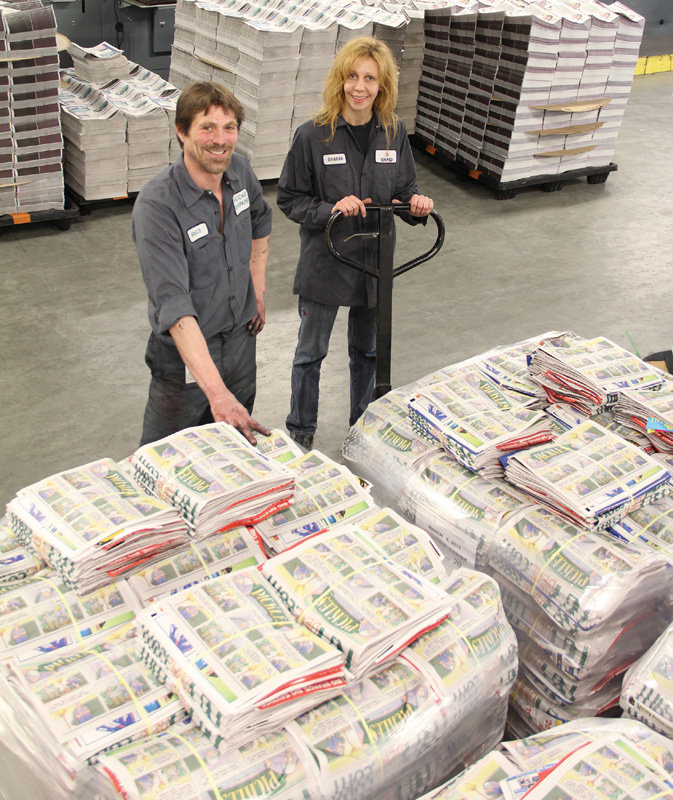
It’s not really a new crossover production trend, this idea of commercial printers (such as Transcontinental) employing hybrid press technologies to pursue newspaper printing, and of newspaper printers (such as Seacoast Media Group) expanding their business model to include commercial print offerings. In this slow-to-rebound economy, however, it’s a diversification proposition worth reconsidering. Set aside the NAA statistics for a moment and read the bottom-line story of Seacoast Media Group (SMG), which ventured into the new territory in 2007 and now is reaping big-time rewards. SMG, a division of Dow Jones Local Media Group based in Portsmouth, N.H., has seen its commercial contract print orders increase by more than 900 percent in the four years since installing a Goss Magnum coldset web press and inserter. The company credits the high automation and versatility of the press among the key reasons for the dramatic success. It prints half a dozen newspapers, including the
Portsmouth Herald and
Exeter News-Letter. “We specialize in offset newspaper printing and everything that entails,” said production manager Alan Laskey. “We have a number of titles with quite substantial run lengths, but no run is too small. The secret weapon in maintaining our service to clients is the level of automation of the Magnum press and the flexibility of the single-width platform.”
13,000 plates per month With the operation running between 15 and 18 jobs daily, each averaging from 45 to 60 minutes on press, according to Laskey, efficiency is essential in keeping costs down and ensuring customer satisfaction. “We get through 13,000 plates per month, which gives an indication of the frequency of job and edition changes,” he said. “The automatic inking, automatic registration, Omnicolor presetting, and the Omnicon controls on our Magnum press maintain job setup, changeover, and waste at a minimum.” Prior to installation of the 16-unit, 2x2 press along with a new Goss inserter, SMG’s printing services were principally concerned with the company’s own in-house publications, with outside contracts accounting for approximately $700,000 annually. Today, the value of contract print work totals around $6.5 million per year and accounts for around 75 percent of the company’s total turnover. This increase is the consequence of both a concerted sales effort aimed at exploiting the full capabilities of the new press, Laskey said, and referrals from existing customers. The single-wide platform also allows SMG to accommodate web widths between 22 and 32 inches, providing the flexibility to print a range of publication formats. Aside from general maintenance periods on weekends, the Magnum runs virtually 24/7, servicing 160 active accounts predominantly from locations throughout Maine, Rhode Island, and New Hampshire, and dispatching as far as New York state. SMG has been awarded the contract to print 28,000 copies daily of the
Nashua Telegraph as well as its numerous weekly titles. This latest assignment contributes to a total output per week of around 1 million copies.
Despite Flooding, Paper Pressed On The devastation of rising water could not deter the dedicated newspaper employees in Vermont, where the
Times Argus and
Rutland Herald have published on time each day since and including the day of a flood in June. A line of mud on a printing press depicted the damage, which president/publisher John Mitchell estimates is anywhere from $2 million to $4 million, including rolls of ruined newsprint. “We continued to get the pages ready even though the editor was doing his pages with his feet in the water, watching the water lap at the side of the building,” Mitchell told WCAX News. Having the majority of its content in electronic format kept the newspapers afloat, so to speak. “If we had not had that cloud computing and that new editorial system, we would have been dead in the water,” Mitchell said, pun intended. Although the paper is still printing, it is no longer from the flooded facility in Barre.
The Burlington Free Press and the
Post Star in Glens Falls have stepped in temporarily to print the
Times Argus and
Rutland Herald. Mitchell said it will be at least another four to seven months before printing resumes in Barre. (All reporters are working remotely, and some editors have temporarily set up shop at the
Rutland Herald.) But the worst part is the 25 workers directly involved in the printing process who have lost their jobs.
KBA Plans More Web-Offset Consolidation At the 86th Koenig & Bauer annual general meeting in Germany, president/CEO Helge Hansen reported that large web presses, including those used for printing newspapers, are a major cause of concern, with global demand well below the level it was at before the global economic crisis. Given the sober market prospects for web presses, Hansen said he sees no alternative but to trim the payroll at KBA’s Frankenthal, Würzburg, and Trennfeld manufacturing plants by 700 jobs to restore competitiveness and profitability in a much-diminished market. Hansen discussed global shifts in media markets, technological advances, and structural transitions within the printing industry. He made it clear that the post-slump capacity adjustments initiated by the top three press manufacturers in 2009 — in the course of which more than 9,000 jobs were lost — were not prompted by a lack of vision or cooperation at the board level. “The merger scenarios mooted would have led to more redundancies and closures, a loss of productivity through staff tensions, and the costs that these entail,” he said. “With industry players working to capacity until 2007, the charge of failing to diversify sooner can only be leveled by those who have no idea how hard it is to change horses in midstream.” However, Hansen conceded that classic press manufacturers must redefine their objectives. Over the past 10 years, KBA has addressed profitable niche markets through acquisitions, reducing its dependence on volume markets such as commercial web and newspaper offset. The group’s non-print-specific business lines with good potential for growth include air purification and industrial coding systems, he said. A further step toward realizing medium-term growth objectives is the licensing agreement announced in March relating to digital print. This will enable KBA to expand rapidly in the inkjet sector by building and distributing new digital press models based on proven technology.
Vertis to Print All ACO Hardware Inserts ACO Hardware, a home improvement retailer with stores throughout the state of Michigan, has expanded its relationship with Vertis Communications (Baltimore), naming the firm its exclusive provider of newspaper inserts, Inserts2online, and logistics. Vertis will showcase the retailer’s collection of home improvement products, personalized service, and special offers through a targeted advertising program that will include the production of single sheets, gatefolds, and eight-page tabs. Vertis will maximize ACO’s marketing investment by driving the content online with its proprietary Inserts2online solution, which transforms print inserts into interactive online content. “Our partnership with Vertis started in 2009, and we have benefited greatly from their consistently high-quality advertising inserts that attract our customers’ attention,” said Jim Zub, director of marketing and advertising. “As we continue to look for new ways to serve and connect with our valued customers, Vertis has stepped up and transformed the information in our weekly ads to also exist on our website, so that shoppers can see our specials and offers with complete convenience.”
Toyo High-Density Process Inks Toyo Ink Group has developed what it calls the Vantean Eco Lio high-density process ink for newspapers. Amid growing interest in the environment, newspaper printers are increasingly demanding more environmentally friendly newspaper inks. The yellow, magenta, and cyan inks in the Vantean Eco Lio series are denser than conventional inks, helping to reduce ink consumption by around 20 percent. With blackness improved and the dry-down phenomenon suppressed, the black ink is designed to allow the standard density to be set to a low level at the time of printing and to help reduce material consumption for the printing process. These inks have also been designed and invented on the assumption of thin-film printing. While maintaining the ease of use of conventional inks, Toyo has successfully enhanced printability. Additional features include: • Advantage in reduced strike-through and set-off with lightweight paper • Reduced ink mist in thin-film printing • Advantage in reduced ink trails on high-brightness paper and lightweight coated paper • Enhanced workability after reduction in ink leftovers, ink drips, and guide roller contamination
Chicago Tribune Grows in Print The Chicago Tribune daily print edition now features more news, more features, and more than 40 additional full pages per week. “It’s a
Tribune created for those who love the printed newspaper,” said the bold headline type in a promo. As the newspaper’s management explained to readers, “We’ve added depth, dimension, and range to our news report to serve you better. We’ve strengthened the newspaper for readers who are serious about their news and love their daily experience with the newspaper. The changes you see … are the result of feedback we’ve received from you over time, and reflect the work of more than 450 of us in the
Chicago Tribune newsroom,” publisher Tony Hunter and editor Gerould Kern wrote. “We are investing in the paper to ensure it remains vital and rewarding.” Total news space is greater than it was five years ago, the paper report. Online, a website redesign also was part of the overall, multimedia brand enhancement.
Gannett Offset Wins WOA Award The 2011 Web Offset Award winners were announced and featured at the 2011 Offset & Beyond Conference. Members of the SNAP (Specifications for Newsprint Advertising Production) committee judged a variety of web- and offset-produced pieces on the degree of difficulty to print; registration; folding, binding, and finishing; and overall craftsmanship. Recipients of the 2011 Web Offset awards included
The News-Review in Douglas County, Ore., Southeast Media in Houston, Journal Graphics in Portland, Ore., and Vertis Communications in Baltimore. Gannett Offset/Springfield received the Best of the Best award in the Coldset category. “The Best of the Best award not only recognizes the individual efforts but acknowledges the overall teamwork and success at both Gannett Offset and
USA Today,” said Mark Winans, president of Gannett Offset/Springfield and vice president of Gannett Offset Print Group.
Miller Newsprint Scoops Newspaper Award The quality of Kodak Versamark inkjet printing systems was emphasized at the 2011 Newspaper Awards in London, where Miller Newsprint’s production of
The Sunday Times was recognized as the best Digitally Printed Newspaper of the Year. (Miller was featured in
E&P last month.) The
Times, also printed by the Maltese firm, was commended, while its production of
The Sun was nominated in the Kodak-sponsored category. “To win, be commended, and nominated in this category is testament to Miller Newsprint Ltd.’s commitment to this market sector,” said Jean Lloyd, Kodak sales and category director of digital print solutions for the UK, Ireland, and Nordics. “We are delighted that … our Versamark product line was able to help this operation transform its business model and go on to be an industry-honored market leader.”
17,000 Paper Reel Pastes, and Counting, Without a Web Break Leading Japanese national newspaper printer and publisher Sankei Shimbun Co. has achieved a new record for successful paper reel changes on its Goss Newsliner presses at the company’s facility in Hokusetsu, Osaka. Between April 2010 and March 2011 the four, 90,000-copies-per-hour presses achieved 17,024 continuous pastes without a single web break. The streak of successful pastes is now in its second year. Sankei Shimbun executives attribute the production success to a combination of press performance, highly skilled staff, and an excellent standard of daily press maintenance. Configured as two five-high and two four-high towers, with one folder and four CT50P reel stands per press line, these Newsliner presses were installed in 2009. They also feature leading Goss technologies such as paper width change capabilities and DigiRail digital inking on all towers. Following installation, the high color quality of the presses became recognized as the “Sankei color standard,” the benchmark for all of the company’s printing plants. The ink presetting capability of the presses routinely reduces start-up waste to less than 150 copies and ensures stable production with a Delta E less than 3. Sankei Shimbun produces more than 1.6 million daily copies of national newspapers through eight printing plants.

 It’s not really a new crossover production trend, this idea of commercial printers (such as Transcontinental) employing hybrid press technologies to pursue newspaper printing, and of newspaper printers (such as Seacoast Media Group) expanding their business model to include commercial print offerings. In this slow-to-rebound economy, however, it’s a diversification proposition worth reconsidering. Set aside the NAA statistics for a moment and read the bottom-line story of Seacoast Media Group (SMG), which ventured into the new territory in 2007 and now is reaping big-time rewards. SMG, a division of Dow Jones Local Media Group based in Portsmouth, N.H., has seen its commercial contract print orders increase by more than 900 percent in the four years since installing a Goss Magnum coldset web press and inserter. The company credits the high automation and versatility of the press among the key reasons for the dramatic success. It prints half a dozen newspapers, including the Portsmouth Herald and Exeter News-Letter. “We specialize in offset newspaper printing and everything that entails,” said production manager Alan Laskey. “We have a number of titles with quite substantial run lengths, but no run is too small. The secret weapon in maintaining our service to clients is the level of automation of the Magnum press and the flexibility of the single-width platform.” 13,000 plates per month With the operation running between 15 and 18 jobs daily, each averaging from 45 to 60 minutes on press, according to Laskey, efficiency is essential in keeping costs down and ensuring customer satisfaction. “We get through 13,000 plates per month, which gives an indication of the frequency of job and edition changes,” he said. “The automatic inking, automatic registration, Omnicolor presetting, and the Omnicon controls on our Magnum press maintain job setup, changeover, and waste at a minimum.” Prior to installation of the 16-unit, 2x2 press along with a new Goss inserter, SMG’s printing services were principally concerned with the company’s own in-house publications, with outside contracts accounting for approximately $700,000 annually. Today, the value of contract print work totals around $6.5 million per year and accounts for around 75 percent of the company’s total turnover. This increase is the consequence of both a concerted sales effort aimed at exploiting the full capabilities of the new press, Laskey said, and referrals from existing customers. The single-wide platform also allows SMG to accommodate web widths between 22 and 32 inches, providing the flexibility to print a range of publication formats. Aside from general maintenance periods on weekends, the Magnum runs virtually 24/7, servicing 160 active accounts predominantly from locations throughout Maine, Rhode Island, and New Hampshire, and dispatching as far as New York state. SMG has been awarded the contract to print 28,000 copies daily of the Nashua Telegraph as well as its numerous weekly titles. This latest assignment contributes to a total output per week of around 1 million copies. Despite Flooding, Paper Pressed On The devastation of rising water could not deter the dedicated newspaper employees in Vermont, where the Times Argus and Rutland Herald have published on time each day since and including the day of a flood in June. A line of mud on a printing press depicted the damage, which president/publisher John Mitchell estimates is anywhere from $2 million to $4 million, including rolls of ruined newsprint. “We continued to get the pages ready even though the editor was doing his pages with his feet in the water, watching the water lap at the side of the building,” Mitchell told WCAX News. Having the majority of its content in electronic format kept the newspapers afloat, so to speak. “If we had not had that cloud computing and that new editorial system, we would have been dead in the water,” Mitchell said, pun intended. Although the paper is still printing, it is no longer from the flooded facility in Barre. The Burlington Free Press and the Post Star in Glens Falls have stepped in temporarily to print the Times Argus and Rutland Herald. Mitchell said it will be at least another four to seven months before printing resumes in Barre. (All reporters are working remotely, and some editors have temporarily set up shop at the Rutland Herald.) But the worst part is the 25 workers directly involved in the printing process who have lost their jobs. KBA Plans More Web-Offset Consolidation At the 86th Koenig & Bauer annual general meeting in Germany, president/CEO Helge Hansen reported that large web presses, including those used for printing newspapers, are a major cause of concern, with global demand well below the level it was at before the global economic crisis. Given the sober market prospects for web presses, Hansen said he sees no alternative but to trim the payroll at KBA’s Frankenthal, Würzburg, and Trennfeld manufacturing plants by 700 jobs to restore competitiveness and profitability in a much-diminished market. Hansen discussed global shifts in media markets, technological advances, and structural transitions within the printing industry. He made it clear that the post-slump capacity adjustments initiated by the top three press manufacturers in 2009 — in the course of which more than 9,000 jobs were lost — were not prompted by a lack of vision or cooperation at the board level. “The merger scenarios mooted would have led to more redundancies and closures, a loss of productivity through staff tensions, and the costs that these entail,” he said. “With industry players working to capacity until 2007, the charge of failing to diversify sooner can only be leveled by those who have no idea how hard it is to change horses in midstream.” However, Hansen conceded that classic press manufacturers must redefine their objectives. Over the past 10 years, KBA has addressed profitable niche markets through acquisitions, reducing its dependence on volume markets such as commercial web and newspaper offset. The group’s non-print-specific business lines with good potential for growth include air purification and industrial coding systems, he said. A further step toward realizing medium-term growth objectives is the licensing agreement announced in March relating to digital print. This will enable KBA to expand rapidly in the inkjet sector by building and distributing new digital press models based on proven technology. Vertis to Print All ACO Hardware Inserts ACO Hardware, a home improvement retailer with stores throughout the state of Michigan, has expanded its relationship with Vertis Communications (Baltimore), naming the firm its exclusive provider of newspaper inserts, Inserts2online, and logistics. Vertis will showcase the retailer’s collection of home improvement products, personalized service, and special offers through a targeted advertising program that will include the production of single sheets, gatefolds, and eight-page tabs. Vertis will maximize ACO’s marketing investment by driving the content online with its proprietary Inserts2online solution, which transforms print inserts into interactive online content. “Our partnership with Vertis started in 2009, and we have benefited greatly from their consistently high-quality advertising inserts that attract our customers’ attention,” said Jim Zub, director of marketing and advertising. “As we continue to look for new ways to serve and connect with our valued customers, Vertis has stepped up and transformed the information in our weekly ads to also exist on our website, so that shoppers can see our specials and offers with complete convenience.” Toyo High-Density Process Inks Toyo Ink Group has developed what it calls the Vantean Eco Lio high-density process ink for newspapers. Amid growing interest in the environment, newspaper printers are increasingly demanding more environmentally friendly newspaper inks. The yellow, magenta, and cyan inks in the Vantean Eco Lio series are denser than conventional inks, helping to reduce ink consumption by around 20 percent. With blackness improved and the dry-down phenomenon suppressed, the black ink is designed to allow the standard density to be set to a low level at the time of printing and to help reduce material consumption for the printing process. These inks have also been designed and invented on the assumption of thin-film printing. While maintaining the ease of use of conventional inks, Toyo has successfully enhanced printability. Additional features include: • Advantage in reduced strike-through and set-off with lightweight paper • Reduced ink mist in thin-film printing • Advantage in reduced ink trails on high-brightness paper and lightweight coated paper • Enhanced workability after reduction in ink leftovers, ink drips, and guide roller contamination Chicago Tribune Grows in Print The Chicago Tribune daily print edition now features more news, more features, and more than 40 additional full pages per week. “It’s a Tribune created for those who love the printed newspaper,” said the bold headline type in a promo. As the newspaper’s management explained to readers, “We’ve added depth, dimension, and range to our news report to serve you better. We’ve strengthened the newspaper for readers who are serious about their news and love their daily experience with the newspaper. The changes you see … are the result of feedback we’ve received from you over time, and reflect the work of more than 450 of us in the Chicago Tribune newsroom,” publisher Tony Hunter and editor Gerould Kern wrote. “We are investing in the paper to ensure it remains vital and rewarding.” Total news space is greater than it was five years ago, the paper report. Online, a website redesign also was part of the overall, multimedia brand enhancement. Gannett Offset Wins WOA Award The 2011 Web Offset Award winners were announced and featured at the 2011 Offset & Beyond Conference. Members of the SNAP (Specifications for Newsprint Advertising Production) committee judged a variety of web- and offset-produced pieces on the degree of difficulty to print; registration; folding, binding, and finishing; and overall craftsmanship. Recipients of the 2011 Web Offset awards included The News-Review in Douglas County, Ore., Southeast Media in Houston, Journal Graphics in Portland, Ore., and Vertis Communications in Baltimore. Gannett Offset/Springfield received the Best of the Best award in the Coldset category. “The Best of the Best award not only recognizes the individual efforts but acknowledges the overall teamwork and success at both Gannett Offset and USA Today,” said Mark Winans, president of Gannett Offset/Springfield and vice president of Gannett Offset Print Group. Miller Newsprint Scoops Newspaper Award The quality of Kodak Versamark inkjet printing systems was emphasized at the 2011 Newspaper Awards in London, where Miller Newsprint’s production of The Sunday Times was recognized as the best Digitally Printed Newspaper of the Year. (Miller was featured in E&P last month.) The Times, also printed by the Maltese firm, was commended, while its production of The Sun was nominated in the Kodak-sponsored category. “To win, be commended, and nominated in this category is testament to Miller Newsprint Ltd.’s commitment to this market sector,” said Jean Lloyd, Kodak sales and category director of digital print solutions for the UK, Ireland, and Nordics. “We are delighted that … our Versamark product line was able to help this operation transform its business model and go on to be an industry-honored market leader.” 17,000 Paper Reel Pastes, and Counting, Without a Web Break Leading Japanese national newspaper printer and publisher Sankei Shimbun Co. has achieved a new record for successful paper reel changes on its Goss Newsliner presses at the company’s facility in Hokusetsu, Osaka. Between April 2010 and March 2011 the four, 90,000-copies-per-hour presses achieved 17,024 continuous pastes without a single web break. The streak of successful pastes is now in its second year. Sankei Shimbun executives attribute the production success to a combination of press performance, highly skilled staff, and an excellent standard of daily press maintenance. Configured as two five-high and two four-high towers, with one folder and four CT50P reel stands per press line, these Newsliner presses were installed in 2009. They also feature leading Goss technologies such as paper width change capabilities and DigiRail digital inking on all towers. Following installation, the high color quality of the presses became recognized as the “Sankei color standard,” the benchmark for all of the company’s printing plants. The ink presetting capability of the presses routinely reduces start-up waste to less than 150 copies and ensures stable production with a Delta E less than 3. Sankei Shimbun produces more than 1.6 million daily copies of national newspapers through eight printing plants.




Comments
No comments on this item Please log in to comment by clicking here